Land, wine and gold: a triple reading of reality
At a time when capital is increasingly looking for safe havens, gold has regained its natural and expected place in the financial armoury of anxious investors. In the third quarter of 2025, global gold demand grew significantly, driven by purchases by private investors, institutions and ETFs - an increase of around 47% in Europe alone, according to the latest sector data.(GOLD AVENUE)
Gold's liquidity is real: it can instantly convert an asset into cash, and its role as an safe investment in times of uncertainty remains undisputed. But the asset debate is not limited to pure liquidity. It concerns what an asset represents when we consider it not just as a financial instrument, but as a relay of value over time and in the physical world.
It's precisely in this respect that wine-producing land in Provence offers a radically different - and, for many savvy investors, complementary and strategic - reading.
Terroir provençal: the experience of uncompromising value
The added value of a wine estate does not come from an instantaneous quotation. It is built from three inseparable dimensions land, production and quality recognition.
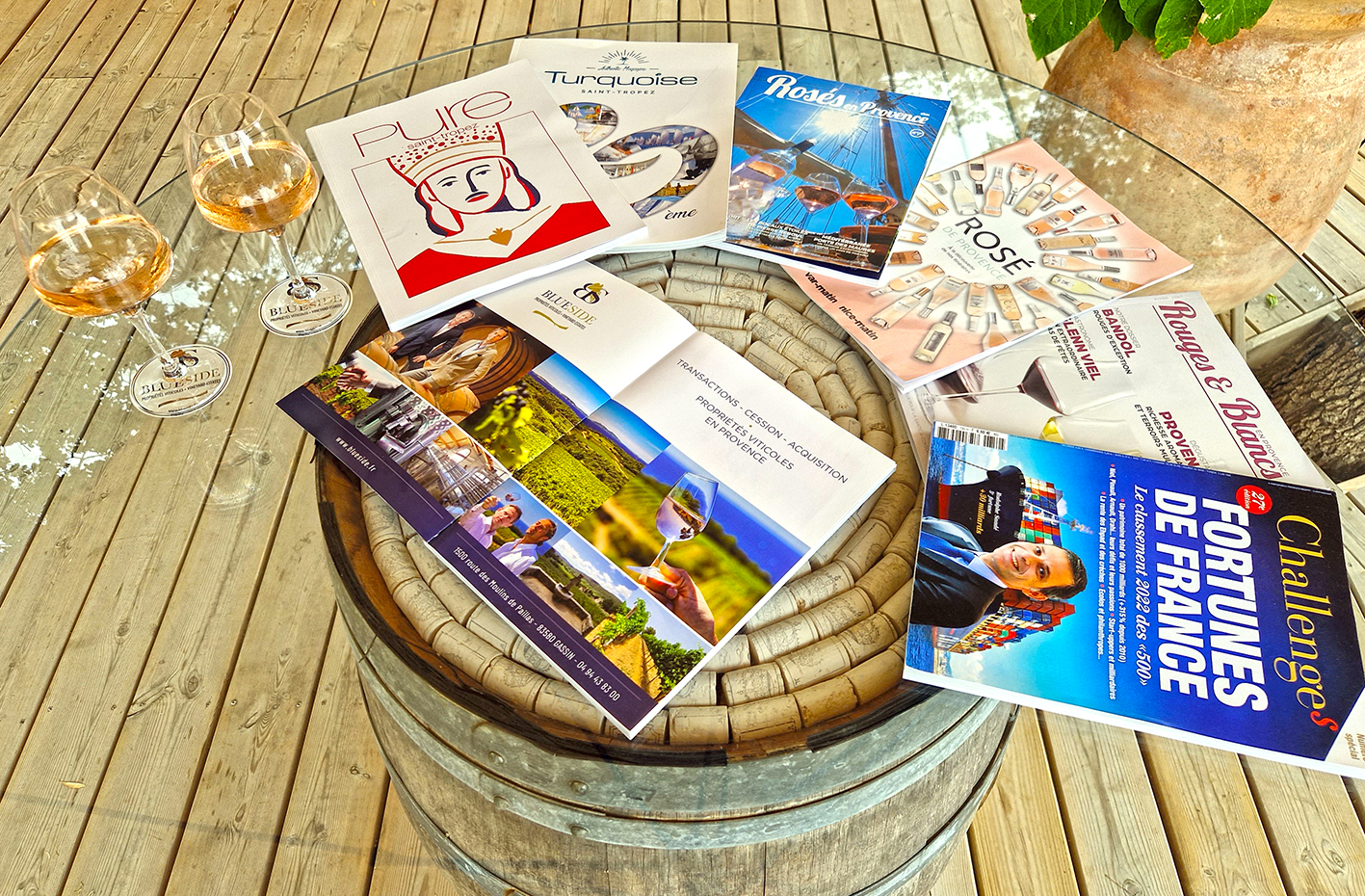
In Provence, the wine-producing property market is holding up better than in other French regions. While the national market has recently seen a decline in both volume and value, quality properties in the Var - particularly in the Côtes de Provence and Coteaux Varois appellations - have seen an increase in sales. sustained demand and steady pricesa sign of rare resilience (Cerfrance Provence Alpes Méditérranée)
This resistance is no coincidence: it reflects a structural alliance between geography, climate and culture. The terroirs of Provence, bathed in Mediterranean sunshine and influenced by the Mistral wind, produce wines - rosés, of course, but also reds and whites - that are not only consumed, but chosen.(Wikipedia)
In this landscape, Provence is not a minor "option": it's becoming a major player in the region. a benchmark wine-growing region for high-end and international marketswhere land scarcity is combined with growing tourist and cultural appeal.
Qualitative resilience to sectoral challenges
It would be naïve to ignore the fact that the French wine industry is facing structural challenges - declining domestic consumption, the withdrawal of certain plots of land under economic or climatic pressure, and the need to adapt business models.(Le Monde.fr)
Even so, Provence is showing qualitative resilience While some regions are seeing their land markets contract, the Provençal areas continue to attract strong demand for well-positioned, high-performance winegrowing properties. This contrast highlights an essential fact for the strategic investor: the productive scarcity of a terroir is not only valued in terms of price, but also in terms of reputation, desirability and long-term value creation potential.
This dynamic can be measured on several levels:
- Land carefully circumscribed and non-expandablewhose scarcity is rooted in geographical and regulatory data.
- Sensory quality and growing recognitionwhich enhance the value of our products and brands.
- Attractiveness for wine tourism and culturewhich helps anchor the asset in a real, sustainable economic environment.(Le Monde.fr)
Liquidity vs. sustainability: two facets of the same wealth objective
Back to gold. Its liquidity is a real advantage when the priority is to protect capital against a sharp fall in financial markets. It protects against inflation, systemic risks and currency fluctuations. And it is precisely for this reason that central banks and many investors continue to accumulate them(GOLD AVENUE)
But with this liquidity comes an absence of use: bullion produces nothing, does not improve, is not part of a territorial history. Its yield is purely correlated to the dynamics of the financial markets.
Conversely, wine-growing land - in Provence as elsewhere - does not have such instant liquidity. It requires in-depth technical reading, a long-term horizon, an understanding of terroir, production, distribution and the global wine market. But it has something that gold cannot offer:
An asset that can be worked, improved, passed on and enhanced by human action as much as by the natural scarcity of the site.
This duality - immediate liquidity on the one hand, meaningful durability on the other - is not contradictory. It constitutes a balanced asset strategy We invest part of our capital in highly liquid securities to hedge against financial uncertainties, while anchoring another part in tangible, productive, culturally-rooted assets that are resilient over the long term.
Why Provence?
Because it embodies a singular form of rarity: that of a an ancient, internationally desirable winegrowing landscape capable of creating and maintaining value in a changing world.
It's no coincidence that transactions in the quality areas of the Var and the major Provencal AOPs remain buoyant, even when other wine markets are faltering.(Cerfrance Provence Alpes Méditérranée)
It's no coincidence either that investors, having sought refuge in precious metals, are beginning to rediscover the appeal of an asset that is lived, cultivated, passed down through the generations.
Conclusion: thinking heritage in three dimensions
Gold offers an answer to uncertainty.
Winegrowing land offers a permanent solution.
Neither is sufficient on its own in a comprehensive wealth strategy.
But combined - with rigor, technical expertise, and vision - they make up a a framework of values that unfolds over time, space and history.
At Blue Side, we don't just see vines and soils.
We see heritage anchorsshaped by centuries, desired by markets, inscribed in reality - and capable of weathering cycles with a strength that only the earth can offer.